

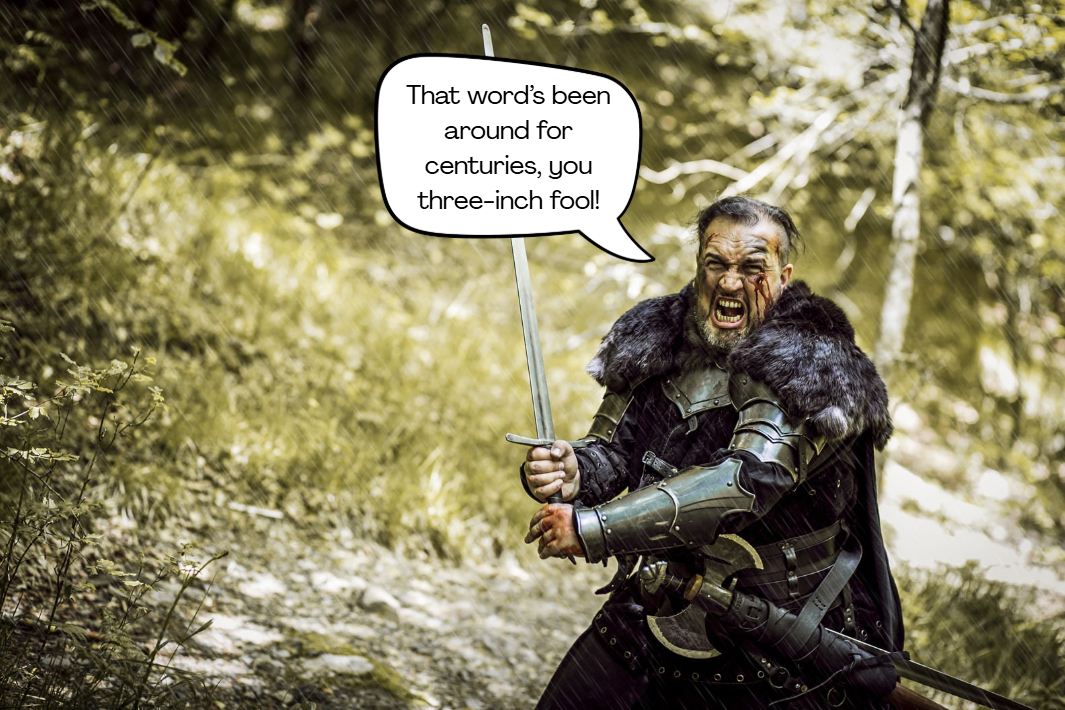
Readers are funny creatures. We can accept futuristic worlds where whales fly through space. We can accept magic and aliens that speak English, and we can accept medieval European settings that are queer normative. Yet we cannot abide the word “okay” in a high fantasy setting.
It’s very odd what does and doesn’t “take readers out of the story.” Of course, readers are not some monolithic group, so what takes one reader out of the story doesn’t faze another. And that only serves to complicate this phenomenon.
But the most frustrating thing is that what “takes a reader out of a story” can be an entirely accurate fact or word usage.
When it’s literally the right word
An editor I recently (and regrettably, but that’s a story for another day) hired flagged “literally” as “Very modern speak” for a novel set in an alternate 1920s.
However, according to Merriam-Webster, this word originated in the fifteenth century and is used pretty much exactly the same today as back then. Here are some examples of “literally” used in 1914 and 1847:
- “Lily, the caretaker’s daughter, was literally run off her feet. Hardly had she brought one gentleman into the little pantry … than the wheezy hall-door bell clanged again and she had to scamper along the bare hallway to let in another guest.” —James Joyce, Dubliners, 1914
- “… yet the wretch, absorbed in his victuals, and naturally of an unutterable dullness, did not make a single remark during dinner, whereas I literally blazed with wit.” —William Makepeace Thackeray, Punch, 30 Oct. 1847
Obviously, this editor was factually wrong, but reality and historical accuracy don’t actually matter to readers. What matters is perceived accuracy—that the story aligns with what the reader believes is true. Or, since there are few things all people believe, what most readers believe is true.
This is called the “Tiffany effect” because the name Tiffany dates back to the seventeenth century but feels modern to many people, and therefore anachronist in pre-modern settings.
Although the modern reader (and editor) has the power of the internet at their fingertips, it seems few choose to use it for research purposes. They’d rather write “very modern speak” than do a quick Google search.
While determining historical accuracy can be challenging, determining what your reader believes is accurate is even more challenging. A good dictionary will tell you the history and usage of a word, but it won’t tell you what the average person believes is the historical origin of the word.
This is where having a good sense of your readership (or your target readership) is critical. If you’re trying to cater toward history buffs that’s obviously a different audience than the average romantasy crowd (a genre where modern slang is fairly common even in supposedly medieval settings). You need to read in your genre and notice how accurate they are and where they commonly deviate from the truth. These shared deviations are “the truth” to this readership.
Handling misbeliefs
If you are aware of a common misbelief and want to fight it, you can handle it by having a character in the story expression the misbelief so you can address it, e.g.,
“I thought swords were heavy,” Bob said.
Alice shook her head. “Longswords only weigh three or four pounds. Rapiers and smallswords weigh even less.”
While this is doable with facts, this is not easily accomplished with language. You cannot pull off the same tactic over a word:
“I literally didn’t say anything,” Bob grumbled.
“What does ‘literally’ mean?” Alice asked.
Bob frowned. “How don’t you know what ‘literally’ means? It’s been in common use for centuries!”
That is obviously clunky and doesn’t work at all. So how do you handle it?
If multiple beta readers and/or editors flag a specific word or phrase as anachronistic, you probably should remove it even if it’s factually correct—which I know is frustrating! But I don’t think you need to remove a word if just one person flags it (unless they’re a person you trust to have a good sense of what the average reader believes).
Reading is always the answer
Overall, the best thing you can do is read widely in your target genre. Read the books your audience reads. This will tell you what words and facts they have already been exposed to and will thus readily accept. It will tell you if they don’t mind some modern words and sensibilities in their supposedly ancient settings.
And, at the end of the day, if you want to stick to the facts, I certainly won’t fight you. There is value in truth, even if it “takes the reader out of the story.”
Enjoy this blog? Subscribe to my newsletter for more content and free books!